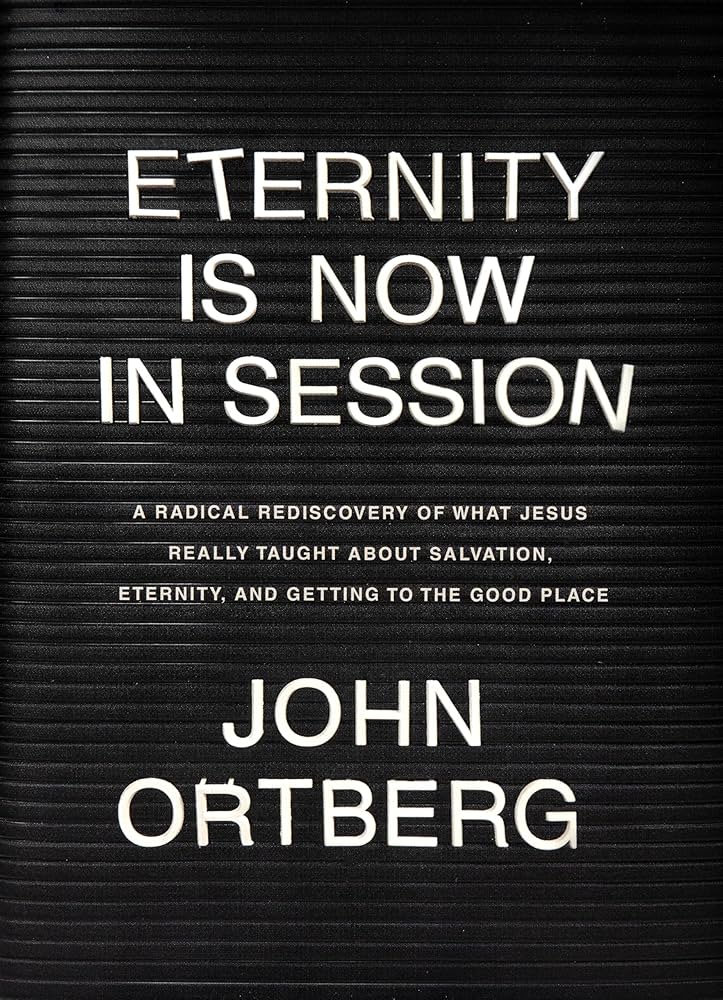
“Eternity is Now in Session” (2018) is a fairly short book by John Ortberg, clocking in at 173 pages.
Ortberg was a close personal friend of Dallas Willard, and Willard’s thoughts and theology are all over these pages.
In brief, this book strikes me as a much-simplified repackaging of some of the key points of Willard’s influential “The Divine Conspiracy” (1998).
Ortberg wants the reader to reflect on the present reality of the biblical concept of “eternal life”, and to reconceptualize Christianity as a lived out discipleship to Jesus now, in this life, rather than a prerequisite series of beliefs and commitments one has to profess before dying and getting to heaven. (All of this is typical of much of Dallas Willard’s work.)
He offers something of a thesis statement for the book on the last page of the introduction:
“This book contrasts two ways of thinking about Jesus’ gospel. The more common version is thought to involve how people ensure they will go to heaven when they die. It’s about how to go from “down here” to “up there.” It usually involves affirming certain beliefs or praying a particular prayer that is thought to make a person a “Christian.”
The other understanding is that the gospel announces the availability of life under God’s reign and power now. It’s about “up there” coming “down here.” By grace. Transcending death. To all who will. For the sake of world.
The first version tends to produce consumers of Jesus’ merit. The second tends to produce disciples of Jesus’ Way.” (8)
One thing I found interesting was Ortberg’s consistent referencing to the “12 Steps” methodology of Alcoholics Anonymous. Ortberg, in his various ministries and writings, has often referred back to the 12 Step methodology as a “Christian idea” that the Church ought to embrace.
Additionally, I ought to give flowers where flowers are due. Ortberg’s writing style is fairly warm and winsome. There are humorous anecdotes and observations throughout, which help to make the book an easier, quicker read.
Overall Recommendation
Altogether, I think this book is helpful. I do think this could be a life-changing book for those who primarily see Christianity as a mechanical religious exchange, obsequiousness in exchange for heaven at death, etc. I agree with Ortberg (and Williard), that isn’t the Christianity of the Bible.
For the reader who is already aware of that common (mis)read of the Bible, I think this book still has value as a launching pad for reflection and discussion. I could see this book being helpful for couples or small groups to read together and discuss, etc.
I’ll close this review with a few quotes:
“Or imagine Jesus tacking a salvation caveat onto the Sermon on the Mount: ‘Everyone who hears these words of mine and puts them into practice is like a wise man who built his house on the rock. Everyone who hears these words of mine and does not put them into practice is like a foolish man who built his house on sand. But just to be clear — you don’t have to worry about actually doing anything I say as long as you believe my death pays for your sins.’
It is unimaginable that Jesus would think or say this. The reason Jesus called us to obey his is not so that we can earn our way into heaven. It is because, as George MacDonald put it, ‘to obey Jesus is to ascend to the pinnacle of my being.’ Obedience–rightly understood–is what a saved life looks like from the inside. Saving faith is faith that allows me to engage in interactive, grace-powered life with him beginning here and now, which death will then be powerless to interrupt. It is faith that allows me to know union with Christ.” (35)
“If we view salvation wrongly, people inside the church feel victimized by a bait-and-switch approach to the spiritual life. First, they’re told that in order to become a Chrsitian or to get “saved,” they have to do absolutely nothing. Then, once they’re in, they’re told they’re supposed to give to the poor, care for the sick and the elderly, and give their time, their money, and their possessions freely and without hesitation. Sometimes they’re told they should do this out of gratitude for being forgiven, which creates the deadly illusion that obedience is something we do for God’s sake rather than because it is the natural way of life for Jesus’ disciples.” (44-45)
“Often today we think of grace as a mere release from consequences. But grace is about something much bigger than not getting punished. If we think of salvation primarily in legal terms of being proclaimed innocent, it leaves our inner persons untouched and unchanged. It makes us think we can want grace without wanting Jesus.” (108)

 TR Hartley
Leave a comment