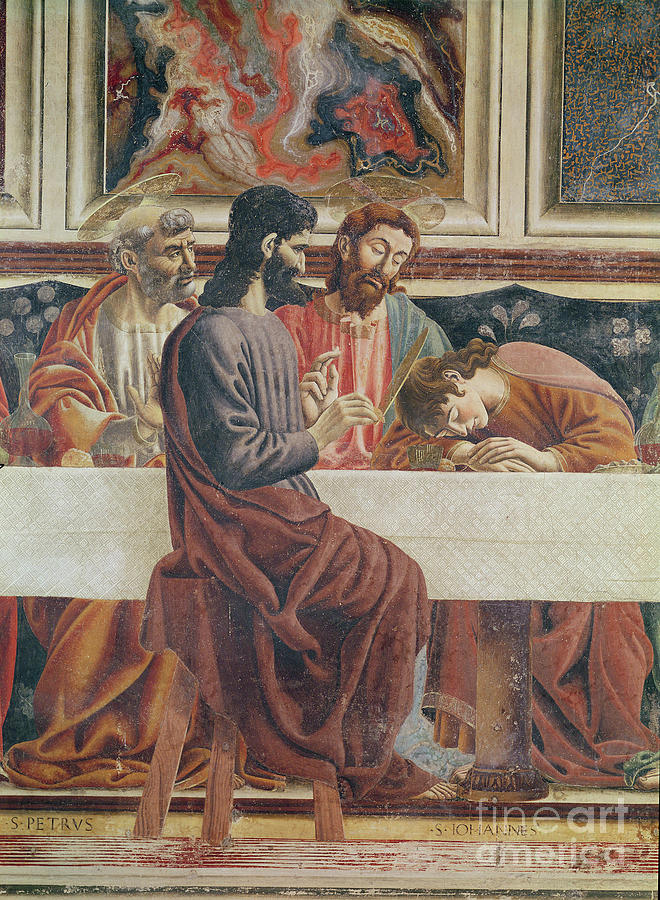
Of Jesus’ primary twelve disciples, two of them, Judas and Peter, really messed up in the week leading up to the crucifixion of Jesus. (I mean, all 12 messed up, but the Gospel authors took time to detail Judas’ and Peter’s failures.) Let’s look at the failure of both Judas and Peter, and see what we can learn.
The Biblical Accounts of Judas’ Betrayal and Peter’s Denial
The authors of the Gospels clearly thought these accounts were important, because these events are carefully chronicled in all of the Gospels. For your convenience, I’ve listed links to the various passages here by topic. Alternatively, you could look at the whole of Matthew 26:1-27:10, Mark 14, Luke 22, John 13 and John 18:1-27.
Judas
Jesus predicts Judas’ betrayal: Occurring in the Upper Room during the Last Supper. See Matthew 26:21-25, Mark 14:18-21, Luke 22:21-23, John 13:18-30.
Judas’ Agreement with the chief priests: Mark 14:10-11, Luke 22:1-6.
Judas’ remorse over his betrayal: Matthew 27:1-10
Peter
Jesus predicts Peter’s denial: Also occurring in the Upper Room during the Last Supper. See Matthew 26:31-35, Mark 14:27-31, Luke 22:31-34, John 13: 31-38.
Peter’s denial of Jesus, and remorse over doing so: Matthew 26:69-75, Mark 14:66-72, Luke 22:54-62, John 18:15-27.
Jesus restores Peter: John 21:1-19.
Judas
Judas famously betrayed Jesus for 30 pieces of silver, and then experienced enormous regret over his actions. Let’s look at Matthew 27:
Matthew 27:3-10: When Judas, who had betrayed Him, saw that Jesus was condemned, he was seized with remorse and returned the thirty pieces of silver to the chief priests and the elders. 4 “I have sinned,” he said, “for I have betrayed innocent blood.”
“What is that to us?” they replied. “That’s your responsibility.”
5 So Judas threw the money into the temple and left. Then he went away and hanged himself.
6 The chief priests picked up the coins and said, “It is against the law to put this into the treasury, since it is blood money.” 7 So they decided to use the money to buy the potter’s field as a burial place for foreigners. 8 That is why it has been called the Field of Blood to this day. 9 Then what was spoken by Jeremiah the prophet was fulfilled: “They took the thirty pieces of silver, the price set on him by the people of Israel, 10 and they used them to buy the potter’s field, as the Lord commanded me.”
What a tragedy. Judas realized he committed a terrible sin, and tried to make it better. When he wasn’t able to, he killed himself. He was without hope; he didn’t know how to turn back to God.
To Judas’ credit, I think we often gloss over the extent that Judas felt remorse over his sin. Judas, the one who loved money more than anything else, was trying to return a rather large sum of money because he wanted to right his wrongdoing. But, his method for fixing things was doomed to fail.
Let’s compare Judas’s sad story to Peter’s.
Peter
Let’s look at a passage from John 21 (emphasis added).
John 21:1-19: 21 Afterward Jesus appeared again to His disciples, by the Sea of Galilee. It happened this way: 2 Simon Peter, Thomas (also known as Didymus), Nathanael from Cana in Galilee, the sons of Zebedee, and two other disciples were together. 3 “I’m going out to fish,” Simon Peter told them, and they said, “We’ll go with you.” So they went out and got into the boat, but that night they caught nothing.
4 Early in the morning, Jesus stood on the shore, but the disciples did not realize that it was Jesus.
5 He called out to them, “Friends, haven’t you any fish?”
“No,” they answered.
6 He said, “Throw your net on the right side of the boat and you will find some.” When they did, they were unable to haul the net in because of the large number of fish.
7 Then the disciple whom Jesus loved said to Peter, “It is the Lord!” As soon as Simon Peter heard him say, “It is the Lord,” he wrapped his outer garment around him (for he had taken it off) and jumped into the water. 8 The other disciples followed in the boat, towing the net full of fish, for they were not far from shore, about a hundred yards. 9 When they landed, they saw a fire of burning coals there with fish on it, and some bread.
10 Jesus said to them, “Bring some of the fish you have just caught.” 11 So Simon Peter climbed back into the boat and dragged the net ashore. It was full of large fish, 153, but even with so many the net was not torn. 12 Jesus said to them, “Come and have breakfast.” None of the disciples dared ask Him, “Who are you?” They knew it was the Lord. 13 Jesus came, took the bread and gave it to them, and did the same with the fish. 14 This was now the third time Jesus appeared to His disciples after He was raised from the dead.
15 When they had finished eating, Jesus said to Simon Peter, “Simon son of John, do you love Me more than these?”
“Yes, Lord,” he said, “You know that I love You.”
Jesus said, “Feed My lambs.”
16 Again Jesus said, “Simon son of John, do you love me?”
He answered, “Yes, Lord, You know that I love You.”
Jesus said, “Take care of My sheep.”
17 The third time he said to him, “Simon son of John, do you love Me?”
Peter was hurt because Jesus asked him the third time, “Do you love me?” He said, “Lord, You know all things; You know that I love You.”
Jesus said, “Feed my sheep. 18 Very truly I tell you, when you were younger you dressed yourself and went where you wanted; but when you are old you will stretch out your hands, and someone else will dress you and lead you where you do not want to go.” 19 Jesus said this to indicate the kind of death by which Peter would glorify God. Then He said to him, “Follow me!”
Peter’s response to his guilt is so different. Though surely wracked with guilt, he didn’t separate himself from other followers of Jesus. He continued on with the other disciples. And he ran to Jesus – he jumped out of a boat to get to Him faster! (He and John ran to the Tomb when they heard it was empty, as well. See John 20:1-10.)
Peter took his guilt, his grief, and his shame, and he ran to Jesus. He didn’t try to clean himself, or excuse his failure. He just sprinted towards Jesus.
What’d Jesus do with that? He restored Peter as a disciple, saying the words all rabbis invited their disciples with: “Follow Me.” (For more on this fascinating passage, you can refer to this article.)
I think it’s significant to observe that both Judas and Peter went to a High Priest when they felt remorse for their sin.
However, there is only one High Priest who is able to actually and fully deal with our sin and shame. Let’s look at Hebrews 4.
Hebrews 4:14-16: Therefore, since we have a great high priest who has ascended into heaven, Jesus the Son of God, let us hold firmly to the faith we profess. 15 For we do not have a high priest who is unable to empathize with our weaknesses, but we have One who has been tempted in every way, just as we are—yet He did not sin. 16 Let us then approach God’s throne of grace with confidence, so that we may receive mercy and find grace to help us in our time of need.
Judas found no help in those religious leaders that always scorned Jesus. They rejected him and his attempts to make things right.
But Jesus welcomed and restored Peter. He is the correct High Priest to which we can and should turn. The response He has for our brokenness is so generous that we can approach Him “with confidence.” (Hebrews 4:16)
Reflection
How about you? Who is the High Priest you generally turn to for absolution when you have guilt? It is yourself? You family or friends? Your pastor?
As I type this, it is almost the end of January. Millions of people made new years resolutions, commitments on how to better themselves in the coming year.
Many of those people have already given up on their resolutions. It’s kind of what we do as people, make lofty goals then fail to live up to them.
My encouragement for you this year is that you would have a different sort of resolution.
Make 2026 the year where you really practice going to the correct High Priest. Make 2026 the year you prioritize first seeking Jesus when you realize you’re in sin or error.
I’m not saying, “decide not to mess up this year”, because you will, in some way great or small. I am saying, when you screw up, take it to Him.
He’s ready and waiting to hear from you.
If you want to read more on repentance, please see “What Is (and Isn’t) Repentance.”



 TR Hartley
Leave a comment