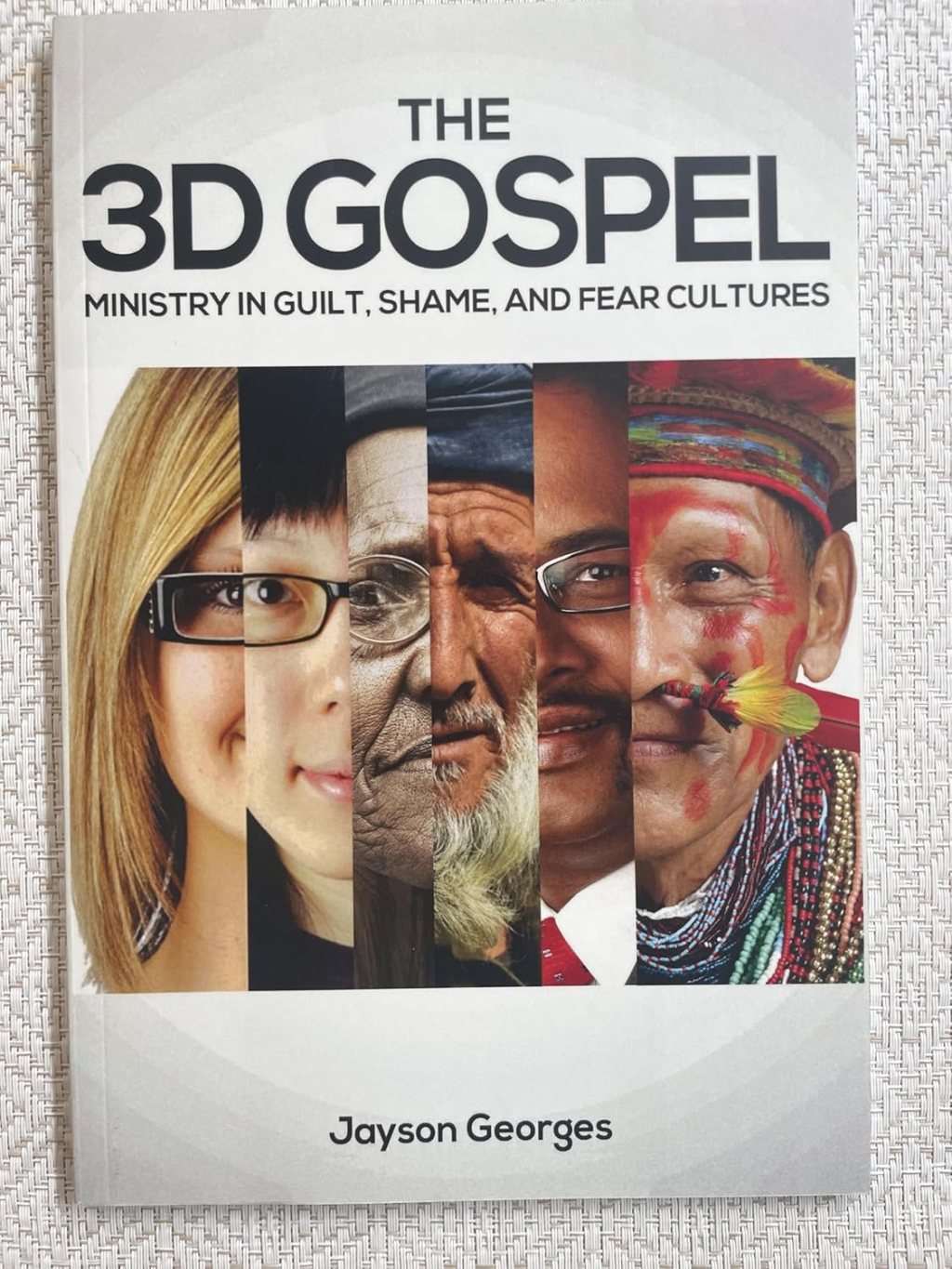
“The 3D Gospel: Ministry in Guilt, Shame, and Fear Cultures” by Jayson Georges is one of my favorite books I’ve ever read. This short book (only roughly 65 pages on my Kindle, not including publishing information, end notes, etc.) is probably the book I most frequently recommend. I would suggest anyone reading this review to follow the above link, buy it, read it, and then share it with others.
Georges’ goal is to help the reader understand the different cultural lenses through which people can view their sin or brokenness, and therefore their different felt needs for a Savior. And Georges accomplishes this goal in a very digestible manner, as his writing style in this short book is clear, concise, and approachable.
In this review, I’ll 1) briefly summarize each of the four chapters, then 2) share some free resources that Georges has provided and then 3) present a number of quotes from the book. (It was tempting to just retype the entire book in the quotes section. I have that high an opinion of the text.)
1) SUMMARY
Chapter 1: Seeing New Realities
This chapter serves to emphasize the reality of the spiritual and moral implications of cultural differences. Georges offers first a short story that illustrates differing values, and then briefly explains each of the three cultural archetypes: Guilt-Innocence, Shame-Honor, and Fear-Power. (See Quote 1 below)
Georges also spends some time looking at how Paul directly addresses each of these archetypes in the book of Ephesians. (Guilt-Innocence is 1:7a, 2:5. Shame-Honor is 1:5, 2:19. Fear-Power is 1:19-21, and 6:10-11.)
Georges concludes the chapter with an illustration of a diamond. (See Quote 2 below).
Chapter 2: Culture
This chapter is gives an overview of each of the three main cultural archetypes: Guilt/Innocence, Shame/Honor, and Fear/Power. Georges notes at the beginning off the chapter that all cultures and individuals exist with some blend of these archetypes, Then, Georges unpacks the distinctives of each cultural archetype. (This section is excellent, and very helpful. My summaries below only scratch the surface of Georges’ observations.)
Guilt-Innocence – Primarily found in Western Cultures, much emphasis is placed on what wrong you do. Your wrong actions demand balancing, and so much emphasis is placed on what you do to make things right. Thus, Guilt-Innocence cultures tend to place an overwhelming emphasis on the individual, rather than the group.
Shame-Honor – Primarily found throughout Middle Eastern and Asian cultures, the emphasis is on group cohesion. Right relationship and reputation with the others in your group is honor, and wrong relationship and reputation with others is shame. And, in these cultures, shame is seen as contagious. You need to ostracize, or punish, the shameful, to keep from becoming shameful yourself.
Fear-Power – Primarily found throughout Sub-Saharan Africa, the primary emphasis is on what will lead to spiritual curses (fear) or spiritual blessing (power). What is right or wrong or good or bad is determined primarily by the spiritual outcome of those actions.
Chapter 3: Theology
This chapter offers a narrative of salvation that would speak to each of the three primary cultural archetypes. I think these are extremely helpful, and I’ve quoted them in their entirety below the other quotations.
In addition to these narratives of salvation, this chapter also lists different verses and terms that speak to the Shame/Honor and Fear/Power cultural archetypes.
This chapter also includes a look at the Fall in Genesis 3 as it pertains to the three cultural archetypes, and then does the same with the Atonement brought about by Jesus’ death.
(The first resource listed in “Additional Resources” below is a chart that summarizes much of this section.
Chapter 4: Ministry
This chapter is aimed at helping cross-cultural workers employ the information from the previous chapters to better communicate the Gospel. This section includes a modified form of the “Four Spiritual Laws” booklet, presenting a four point presentation of the Gospel for each of the cultural archetypes. It also looks at the different ways to communicate the Gospel to larger audiences in each cultural archetype: The “Truth Encounter” for Guilt-Innocence cultures, the “Power Encounter” for Fear-Power cultures, an the “Community Encounter” for Shame-Honor cultures.
Conclusion
The book then concludes with a few summary remarks, questions for discussion and reflections, and a list of additional resources.
2) ADDITIONAL RESOURCES
Georges has also provided a very helpful chart that gives an “at-a-glance” summary of much of this, which you can view here.
Because Georges wants his book and work to be as helpful as possible, he’s added a lot of free resources that you can find at https://honorshame.com/.
3) QUOTES
(The pages listed are based on the Kindle edition, which are variable based on font/size. Correct numbers may vary.)
- “Christian missiologists identify three responses to sin in human culture: guilt, shame, and fear. These three moral emotions have become the foundation for the three types of culture: (1) guilt-innocence cultures are individualistic societies (mostly Western), where people who break the laws are guilty and seek justice or forgiveness to rectify a wrong, (2) shame-honor cultures describes collectivistic cultures (common in the East), where people shamed for not fulfilling group expectations seek to restore their honor before their community, and (3) fear-power cultures refers to animistic contexts (typically tribal or African), where people afraid of evil and harm pursue power over the spirit world through magical rituals.” (10)
- “The gospel is a many-sided diamond, and God wants people in all cultures to experience his complete salvation. But despite the multi-faceted nature of Christian salvation, Western Christianity emphasizes one aspect of salvation (i.e., forgiveness of sins), thus neglecting other facets of the gospel of Jesus Christ. Imagine a diamond with only one side! For cross-cultural workers, a truncated gospel hinders spirituality, theology, relationships, and ministry. We unintentionally put God in a box, only allowing him to save in one arena.” (13)
- “But the God of the Bible desires to bless all peoples with the fullness of salvation in Christ. The calling of the Church is to meaningfully introduce the nations to the God who addresses our deepest cultural and spiritual longings.
But the 3D Gospel is for Christians, especially those in ministry, just as much as for unreached cultures. Theological tunnel vision that only sees one facet of the diamond shackles our own relationship with God. Western Christians may fully trust in Jesus for the forgiveness of sins, and be plagued by shame and fear. Christians often feel ashamed for “not being good enough” and try to mask apparent deficiencies. Feeling inadequate or worthless because of past abuse or recent failures hinders our intimacy with God.” (73)BIBLICAL NARRATIVES OF SALVATION
- The Guilt-Innocence Narrative of Salvation (34-36)
“God is perfectly holy and just. In all His ways, He acts with perfect righteousness. Sin never enters His presence. This God created the entire world out of nothing.
God created Adam and Eve and placed them in the Garden of Eden. He gave them freedom to eat from any tree, but clearly instructed them to not eat from one tree—the tree of the knowledge of good and evil. But when Adam and Eve disobeyed God’s commands, they faced the consequences—physical and spiritual death. They were disciplined for their transgressions. Because of their actions, people are born into a state of sin, naturally opposed to God and his law. Sin separates all people from the holy God. Adam and Eve were banished from the Garden of Eden.
God gave Israel the Law, which had two main functions. First, the Law revealed to people their moral inadequacy and need for salvation. Israelites were unable to fulfill all of God’s commands by their own strength. Human efforts can never reach the divine standard of holiness. Israel’s history is one of repeated disobedience and subsequent punishment.
But the Law also included provisions for forgiveness of sins. God provided a means for people to make an atoning sacrifice for their transgressions. Israel’s sacrificial system allowed for forgiveness through the ritual sacrifice of spotless animals. The Passover during Israel’s exodus from Egypt foreshadowed how shedding blood saves people from God’s wrath.
Jesus Christ, God’s own Son, became the perfect sacrifice to take away the sins of humanity. Jesus lived a perfectly sinless life. Having no sin of His own, He was able to take our sin. Jesus was the perfect Lamb of God. He was pierced for our transgressions and bore the consequence of our iniquities. Jesus’ death on the cross forgives our trespasses and cancels the record of debt that stands against us. Then, Jesus rose from the dead and went to heaven.
God is now building His church from those who repent of their sins and believe in Jesus. To become a follower of Jesus, one must recognize and confess the truth of their sin before God, as moved by the conviction of the Holy Spirit. Because Jesus reconciles us to God, our efforts towards moral perfection are in vain. We are saved by faith as a gracious gift from God, not by our own merit. Being forgiven of our sins, we are called to forgive others.
When Jesus returns to the earth, God will judge all people justly and punish sin. The wicked will be condemned to hell and the righteous will spend eternity with God in heaven.”- The Shame-Honor Narrative of Salvation (36-40)
“God has existed for all of eternity in full glory and honor. He is an honorable King, a Father who provides for the entire family. He is pure, faithful, and glorious—the essence and source of all true honor.
To magnify his glory, God created the world and spoke life into being. From the ground, God created Adam and Eve, crowning them with honor and glory. They possessed authority to rule over creation as God’s esteemed co-regents. As God’s children, they lived under God’s name. Adam and Eve enjoyed an honorable identity from God. They walked naked and were not ashamed.
But Adam and Eve were disloyal to God. They forfeited divine honor to pursue a self-earned honor. Their disloyalty to God created shame, so they hid and covered themselves. Moreover, their sin dishonored God. God lost face. Because Adam and Eve brought shame upon everyone, God banished them from His presence to maintain His dignity.
As descendants of Adam, we inherit their original shame. Then our own defiled and disloyal heart increases shame. This shame shapes our identity and behavior. Sin (i.e., abuse, anger, gossip, boasting, racism, violence, war, etc.) is largely the false attempt to cover shame and fabricate honor. We manufacture a false status, often by shaming others or boasting in the superiority of our own group. Having lost our spiritual face, family, name, and status, our life is a perpetual effort to construct a counterfeit honor. As the tower of Babel story illustrates, people seek to exalt themselves and to make a name for themselves. Our shame causes disgraceful conduct and dishonors God.
God then initiated a plan to restore human honor. He covenanted to honor Abra(ha)m with a great name, land, blessing, nation, and many children. As a great nation, Abraham’s family would become God’s instrument to bless—or honor—all nations. When Abraham’s descendants suffered in slavery in Egypt, God delivered them from shameful bondage. Israel became the most prized nation, the apple of God’s eye and treasure of His heart.
God made a special covenant to honor Israel, if only she would honor God with loyalty and obedience to Torah. The regulations of Torah cleansed Israelites’ defilement and allowed them to be restored to the community. Though God intended for the covenant to produce honor, Israel’s frequent disloyalty defamed God’s name among the nations. When turning to other gods, she marred God’s face as an unworthy spouse. Israel’s chosenness led to ethnocentrism—group righteousness. They believed Gentiles were inferior and unworthy to be in God’s family. Israel, like Adam, was chosen for honor but ended up in shameful exile. Even though Israel’s story ends in national shame, promises and instances of divine exaltation (i.e., Ruth, David, Daniel, and Esther) foreshadow a greater intervention to rescue the human family from shame and restore its honor.
Though He was eternally glorious and honored in heaven as God’s son, Jesus became a lowly human being in order to save people from shame. His miraculous healings and radical table fellowship restored dignity and honor to marginalized people. Jesus was so full of divine honor that those who touched him became cleansed and accepted. His teaching proclaimed the true, eternal code of honor. By loving and accepting all people regardless of their reputation, Jesus undercut society’s false honor-code, and offered divine honor to humanity. Jesus’ life fully honored God.
But Jesus’ ministry threatened the earthly honor of established leaders. So they responded by shaming Him, publicly and gruesomely. Jesus was arrested, stripped, mocked, whipped, spat upon, nailed, and hung naked upon a cross before all eyes. He faithfully endured the shame and broke its power. The cross restored God’s honor and removed our shame. Face was restored.
God then publicly approved of Jesus’ shame-bearing death by resurrecting him to glory. Jesus now sits at God’s honorable right hand with a name above all others. Whereas Adam and Israel failed, Jesus succeeded in being truly human; his life honored God and the human family.
Those who give allegiance to Jesus will receive a new status. Their shame is covered and their honor restored. People must renounce games of social manipulation, status construction, and face management to instead trust fully in Jesus for new status. Membership into God’s family is not based on ethnicity, reputation, or religious purity, but by one’s familial allegiance to the crucified Messiah. God exchanges our old status as unclean, worthless, and inferior orphans for the status of pure, worthy, and honorable children. Those who follow Christ to the cross of shame will also follow him into resurrection glory.
Being welcomed into God’s family allows people to welcome and accept other groups. Christians are able to honor others and glorify God since they possess God’s eternal honor and empowering Spirit. Upon Jesus’ return, unbelievers will be stripped of all worldly honors and banished to everlasting shame; while believers will receive crowns of eternal honor as God’s glory fills all creation.”- The Fear-Power Narrative of Salvation (42-45)
“In the beginning, the creator God made the word by His powerful word. God is sovereign over all creation, the heavens and the earth. In love, He rules with absolute authority and power, and creation praises His mighty strength.
Having made the world as His kingdom, God appointed Adam to reign over the creation. Adam was God’s co-regent, the prince of creation. He was giving dominion to rule God’s creation, symbolized by his right to name the animals. As Sovereign King, God appointed humanity to rule His world.
At some point, a host of spiritual angels rebelled against God’s sovereign rule. Satan, the adversary, led the mutiny. The devil schemed to expand his illegitimate power over the earth by bringing humanity under his rule. The crafty serpent wooed Adam and Eve out from God’s kingdom into his domain. The rebel forces subjugated humans. Adam’s family lost its position of power and authority in the world.
Satan is now the de facto ruler. He became the new prince; we were born into his kingdom. People’s eyes are blinded and hearts are captured by Satan. Sin, spiritual attack, and idolatry enslave human souls to dark forces.
To reclaim ultimate sovereignty over His kingdom, God selected Israel to be His special instrument in the spiritual battle. Through a covenantal relationship with Israel, God would expand His dominion to all nations. When Israel was oppressed in Egypt, God confronted the Egyptian gods to liberate them from the bondage of Pharaoh. The exodus demonstrated God’s power to all people.
God is a mighty warrior, whose heavenly power over evil translates into earthly conquest. When Israel relied upon God, He grated victory regardless of their military disadvantage. But too often they sought power in the wrong places. Israel succumbed to the temptation of false gods in idolatry and occult practices. Instead of depending on the Lord of Hosts, they allied with the gods of Canaan and rulers of larger nations to ensure protection and blessings. Prophets proclaimed and demonstrated God’s superiority over the Canaanite gods, but Israel remained powerless to escape Satan’s influence.
God’s liberating power incarnated in the person of Jesus. He inaugurated God’s long-awaited kingdom. Fully empowered by God’s spirit, Jesus resisted Satan’s offer of co-rulership and remained committed to God’s mission of dismantling Satan’s kingdom. On an unprecedented scale, Jesus delivered people held captive by Satan. By healing the sick, raising the dead, and casting out demons, Jesus disarmed Beelzebub to plunder his kingdom and set the captives free. Because God was with him, Jesus saved all who were under the power of the devil.
The powers thought that killing God’s Son would solidify their authority in the world. Their plan backfired. The death of Jesus Christ was the deathblow to evil forces. The cross disarmed the powers and authorities and publicly triumphed over them. Then in the ultimate display of divine power, God resurrected Jesus. Jesus rose from the dead to a position of power and dominion far above all rule and authority.
People must now turn from dark powers and submit to Jesus as Lord. Believers in Jesus are transferred from the kingdom of darkness to the kingdom of light. God raises us up with Christ and seats us with him in the heavenly realms, so that we too have a power and dominion far above all other authorities. God’s grace restores our authoritative position in the world. We are co-heirs with Christ.
With constant access to God’s Spirit, we now stand firm against Satan. Though Satan continues as a lion on the prowl, Jesus shields us from his evil influence as we affirm our identity and authority in God’s anointed Son. God blesses Christians with every spiritual blessing in the heavenly realm, rendering black magic and occult practices spiritually futile. As Christians walk by God’s Spirit in faith and love, we conquer the enemy and strip off enslaving sin. The battle concludes when God binds Satan’s forces and then rules the world from His throne for all eternity with His people.”

 TR Hartley
Leave a comment